Crip Freedom
When I think about crip freedom, I think not about the abolishment of impairment, or even of losing disablement completely, but instead about experiencing space without constant negotiation.

I went to the beach a little while ago. I walked down, along the boardwalk, admiring the deep azures and clear turquoises against the golden sand, palms standing tall. I reached the area where I wanted to swim, and crossed to the middle of the beach, where I found sun-loungers in a mix of sunlight and dappled shade, and laid my towel and stuff out on one of them. I soaked in the sun for a while before deciding to go into the sea. I went out into the sea, and floated there for a while, enjoying myself until I began to become cool, at which time, I came out of the sea, showered off the sand, and lay in the sun, letting it dry me.
That paragraph sounds normal, and yet represents a taste of freedom so rarely apportioned to disabled people.
I went to the beach a little while ago. I googled to find that there should be adapted sea swimming on weekdays from that particular beach. On the day, I walked along a beautiful seafront boardwalk, filled with disabled people (if you build it, they will come). I admired the deep azures and clear turquoises, the frequent boardwalks jutting out into the golden sands, the tall pines scraping the sky. I reached the Red Cross lifeguard base where the adapted sea swimming was apparently based, and followed the boardwalk out to a covered area in the middle of the beach - a stiff wooden platform suitable for my chair not to struggle even slightly. I found sunloungers in the sun, and sunloungers in the dappled shade, and a crew of qualified and trainee lifeguards standing by the adapted swimming chairs. I asked them how it worked, and they told me to return when ready, so I changed to swim, soaking in the sun. Once ready, I went back, and three men carefully lifted me from my electric wheelchair into an amphibious wheelchair, casually, with no implication that this was in any way burdensome. I strapped on my swimming float and hand paddles, and they wheeled me into the sea, gently tipping me out once the water was deep enough. For about 45 minutes, I floated there - at first, four of the lifeguards observed me for safety, slowly peeling off to a single man who was never more than three metres from me, guarding my safety against the current. Once I was tired, I signalled to him, and his colleagues brought the amphibious chair to get me out of the sea. Up on the beach, they took me to the shower and gently showered me off, scrubbing my head, before taking me back to my chair. It took a few attempts to get the lift right - and only after they’d successfully transferred me did I learn they had a hoist and could have hoisted instead, but it was nice, in some ways, to be lifted - for it to be a personal, not a mechanical matter. I spread my chair out to dry, and tired, to soak off in the glorious sun.
The world is built for normative bodies. Whether you have one or not, hearing this is unlikely to be a shock for you.
It is designed for bodies navigating it in specific ways - climbing stairs, for example - even though many people cannot climb stairs. Whether it’s the environment itself, steep and impassable, or whether it’s the rules and systems built within that to exclude, a fundamental part - indeed, for me, a defining part of being disabled is these unwanted and unexpected barriers.
Barriers are pervasive. It’s not just the buildings that announce with four proud steps that people like me are not welcome; it’s the promise of access in the form of policy that offers rights, toothless and unenforced in practice.
It’s also the attitudes I’m faced with, and the way people assume I’m incompetent, the pity people give me. It’s the time it takes me, far longer than anyone non-disabled, to complete all the planning and contingency my normal life requires. It’s systemic and bureaucratic barriers that are built to treat every disabled person as disbelieved.
When I think about crip freedom, I think not about the abolishment of impairment, or even of losing disablement completely, but instead about being able to experience space without constant negotiation for my needs to be met. Just the freedom to do things without pleading, begging, and being the supplicant.
This is crip freedom for me. There was no bureaucracy, no requirement to book, no request for evidence, no fee. Nothing beyond the belief that disabled people too should be able to enjoy the sea. And yet it’s so vanishingly rare to be gifted that moment of sheer freedom and recognition of humanity.
So often, disabled people are only given bread - the bare necessities of survival, but in being given the chance to swim in the sea, like anyone else, my needs are not a burden or a challenge - that was being given roses too.
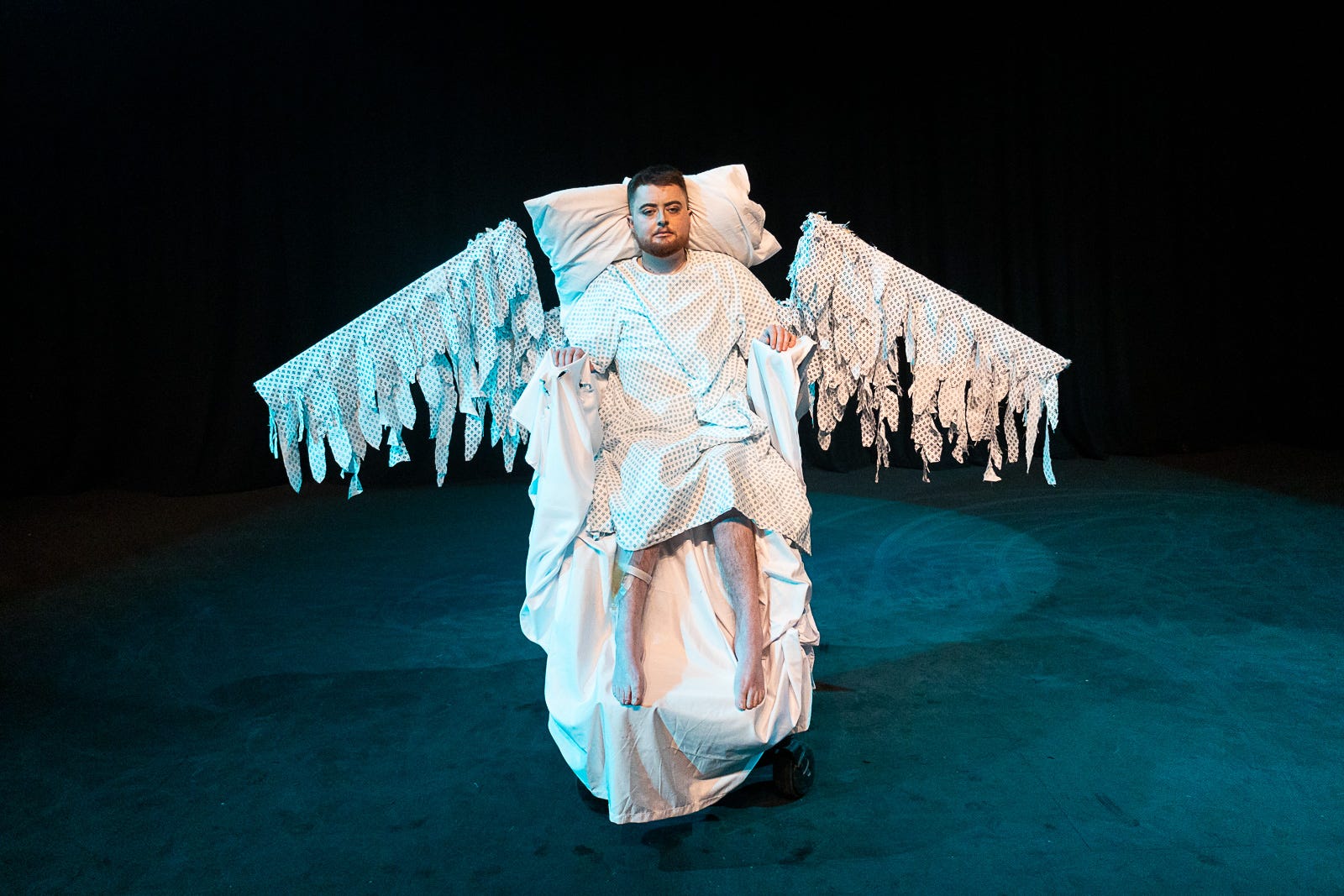
This image is iconic
Thank you for this beautiful exposition - I don't think I'd ever fully appreciated the cost of all those negotiations quite so clearly as when you laid out this beautiful example. And I'm aware that the negotiations I face due to my disability will be nothing like as immense as those you have to deal with on a daily basis. Thank you, I feel seen, I feel validated, I feel like you have given a voice to something I could not have articulated before, but can now name. Holly