Crip Fury
When you have to perform gratitude to survive, where does your anger go?

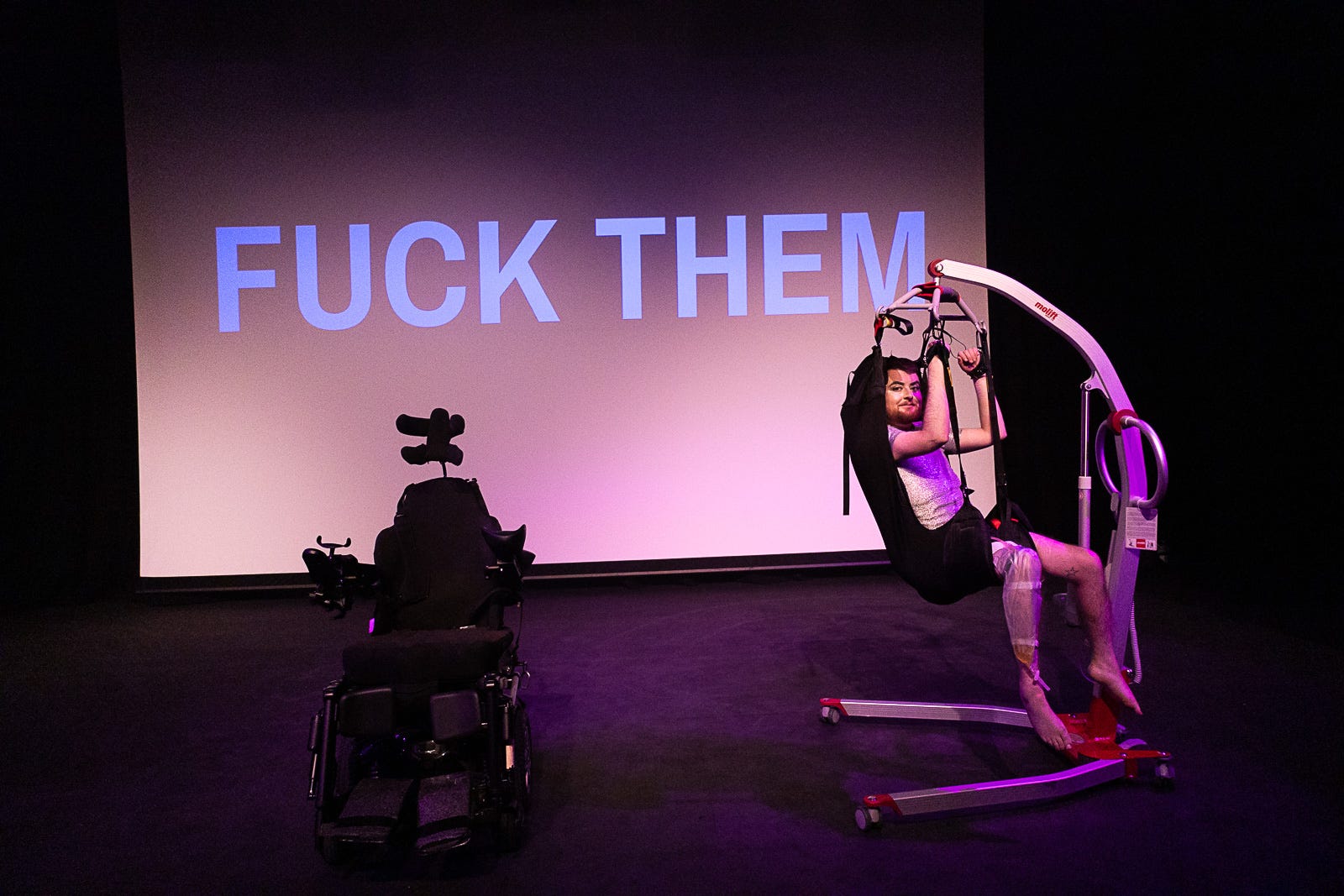
When something is not working, sometimes someone will have to fix it. The problem will be solved, and something that seemed intractable will be navigated round. At that point, disabled people are expected to be grateful for the extra labour that went into making something possible for us, as if the impossibility of it were a natural way of being in the world and the work done to fix it were a gesture above and beyond, rather than the bare minimum.
The grateful cripple
We are expected to be patient while we wait for that fix. We are expected to tell our stories in ways that are inspirational. We are expected to be a lesson for others: the lesson that one can suffer gracefully.
This is work, this performance. I spend so much energy on gratitude I don’t feel, and on patience that I am not shown by others. Over a lifetime, this comes to eat away at you. I sometimes feel like I can slip into the skin of a grateful character because it costs so much to actually hold that gratitude when I don’t feel it.
The bitter cripple
I become angry. That gets reframed as bitterness in the face of genuine hard work and generosity of people who are trying to make things accessible. It gets framed as a failure to adapt to being disabled, and it gets framed as a symptom of being disabled rather than as a reasonable response to the world.
There are versions of disabled anger that are more acceptable, more palatable. The fighter, the campaigner, the overcome-r. But the problem with that is that until the moment where your narrative arc ends in triumph, you are that bitter, disabled person. It’s only when you win, it’s only when you prove that you were right all along, that this creation is allowed to be seen to embody a positive anger.
And that positive anger is designed for non-disabled consumption. It’s designed to reassure them that challenges can be overcome, the spirit cannot be broken, and that you can win. It shows them that they will be alright, instead of highlighting the non-disabled complicity in building a disabledist world.
Listening to anger
I’ve almost forgotten what it would be like to listen to my anger, so afraid of it I am. But actually, anger as a response to inaccessibility is a rational response to a real situation. It’s telling me I deserve better, and it’s usually right.
It often feels disproportionate, but sometimes it’s entirely proportionate to what’s been done. If I have been shut out of a building as I watch hundreds of others flood in, then I have every right to be, well, furious. And if my anger is genuinely disproportionate, then maybe that’s because it is the anger of situation after situation bubbling up.
Fundamentally, this anger isn’t about my own misfortune; it’s also about the structural hostility I face everywhere in the world. It’s the way that I constantly encounter systems that are designed to exclude me and have never had inclusion adequately retrofitted into them. It’s about how all of these decisions about what I should and shouldn’t be allowed to access in the world are made without me, even when they affect me.
Whether we’re thinking on an individual level of care and assessments or a cultural level of transport and buildings, this is a world that does not account for me and people like me (and nor does it particularly want to change that). Then there is a specific fury of watching this inaccessibility be framed as my problem to manage, rather than recognised as a failure that the world needs to fix.
Partially, it is that so much of my anger has nowhere to go. It’s not released, it’s not performed for anyone, and it’s not resolved by a policy change or a campaign. Instead, it just sits there: a vicious reminder of the ways in which the world is unfair.
Bitterly angry
This does, in some ways, make me bitter. It’s a heavy anger to carry, especially alongside exhaustion, and it flares at moments when I am not expecting it to. I’m not always able to use it productively, and thus it builds because the injustices keep building. I feel like there are no healthy ways of expressing it.
When I do express it, disabled anger gets pathologised. It’s treated as a symptom or evidence of poor adjustment, but it’s also used as a reason to question my account of my experience. If I’m angry and upset about discrimination done to me, people will not listen to me about that discrimination because I’m ‘too angry’.
The risk of being angry involves being labelled difficult, being dismissed, and being refused the support we need to exist in the world. I dare not appear angry at the people who fund my care for fear that I will lose my care entirely. It is a constant calculation about when I can afford to be angry, and in front of whom.
Expressing anger
So what do I do with my fury? Otherwise, I can transmute it into art, into advocacy, into writing, into things that don’t just consume me. Sometimes I can and sometimes I can’t. Sometimes I’m just angry, and my anger doesn’t have to produce anything to be legitimate.
At the same time, art is a great place to express this anger. There are places in my solo show, ‘Quality of Life is Not a Measurable Outcome’, where I really draw deep in order to react to the kinds of treatment I am used to experiencing (though even then, it is made palatable for an audience).
What about if there was a case for fury? A case where we weren’t expected to manage it, to overcome it, or to channel it into something palatable, and instead were able to listen to our fury because it is usually pointing at something real and important?
What about disabled people being angry in ways that don’t comfort or reassure, that refuse to perform gratitude for inadequate provision in the way that we’re meant to?
I’m trying to learn to say what I’m angry about plainly, without apology and without softening it. I want to make clear what things should be different and are not, expressing my rights, not necessarily as a call for action in that situation, and certainly not expecting that a resolution could be found. It is about just holding on to that fury, acknowledging it, and leaving it in the space for somebody else to pick up, because it’s not actually always my mess.
So much love ❤❤❤.
I've been feeling really angry lately and hearing you talk about it has helped me feel at peace with just letting the rage exist, without trying to fix, without trying to surpress it, just letting it be. Thank you
Excellent piece, Jamie, thank you for writing it! You expressed lots of things that have been on my mind. It also made me think how much research I've seen in recent years about the role of anger on our physiology. "Minority stress" is very real, and evidence increasingly suggests that being in a state of rage long-term can contribute to illness. And then I think about how lots of the ways that people talk about "expressing" that anger (ie. getting our bodies out of that unproductive state of activation) are just not inaccessible to a lot of disabled people (eg. boxing or, say, running)! So our fury, if unexpressed, is probably disabling us further.