Crip Grief
How do we talk about our bodies? How do we not talk about our bodies?

Content notes for grief, disease progression and ableism
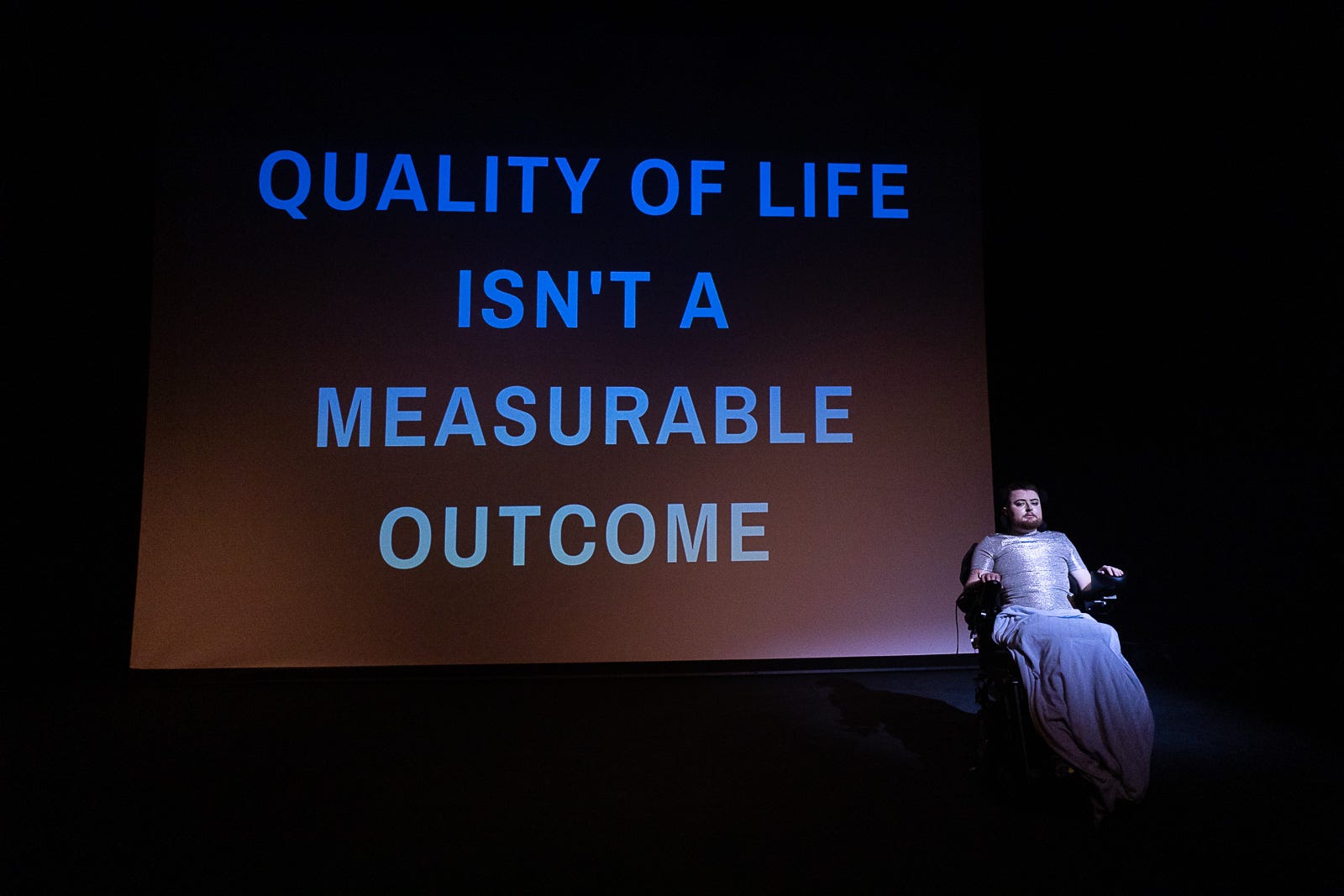
Grieving is a part of being human, a ritual as old as time itself. A bereavement, a loss with a name, a ritual to close it off. The world recognises that grief, and yet, for me as a disabled person, there’s never been a recognition of the way I experience grief. Grief exists as a stage to pass through, rather than something to actually feel. You’re allowed to be in one of the stages, perhaps, but the idea is you should always move on. You shouldn’t remain stuck in denial, in anger, or in bargaining; you should instead reach a time and place beyond grief where you have found some peace.
The grief that you are allowed is a finished, resolved, closed, and private grief. This is not the grief I carry. The grief I carry is recurrent and inconvenient.
Writing about grief when you believe in the social model
I’m nervous writing about grief and disability. It feels very politically dangerous to talk about grieving because it feels like it concedes the pity narrative of ‘isn’t it awful to be disabled’. The social model tells us that disability is done to us by the world; therefore, what are you mourning? My immediate answer to that is all the parts of the world I cannot access, but I also mourn things more intimate and more impairment-centric as well.
I don’t want to be unable to talk about grief around the loss of function of my body without someone telling me that it is not ‘social model’ of me to do so. Nor do I want people to insist that I talk about the personal when I discuss the grief I experience regarding barriers in the public sphere.
I don’t believe there is an easily resolvable tension between these things, but I think the route towards understanding it is the one that recognises that the social model is a political organising model, about those barriers imposed on top of our impairments.
Much of my grief is also about barriers on top of my impairments, but some of it is about my impairments themselves. It takes a lot of courage to admit that.
What is there to grieve?
What am I grieving? This is a good question.
One of the key things I’m grieving is the body I thought I had: a body that I slowly discovered didn’t work the way I thought it did and would continue to work less and less and less.
Alongside that body is my future self. It was the plans and dreams that I had that were not possible with the body or mind I have. Yes, if the world were a different place, they might have been. I might have been able to have the support and funding I needed to move abroad, but I don’t, and therefore that grief sits with me (even if much of it is grief about barriers I face).
I didn’t expect to become a version of myself that was so dependent on others, and whilst in many ways I have come to accept that, in some ways I feel I have never really been allowed to mourn all of the things that I thought I would be as compared to the things that I became.
I grieve my privacy. I have lost so much of it to care, to medical systems, to care assessments, and to carers; all of these things make your body into a form of public property. I have lost that sense of ownership over myself because I have been in so many situations where there has been no option but to consent to something intimate and invasive. After all, the cost of that could be survival.
I grieve spontaneity. I grieve the fact that I used to be able to do things far more freely, and everything now requires planning, support, and contingency.
I grieve a lot of my friendships. Many of them didn’t survive just because, for so many years, I was too ill to do anything, and in that time, I drifted away from people and they from me.
I also have a painful kind of anticipatory grief. It’s not just grieving the things I’ve lost, but it’s also grieving the things I haven’t yet lost and am waiting to lose. It’s the particular cruelty that unpredictable and progressive conditions can have: you know that something is coming, and you know what it will be, you just don’t know when.
Finally, for this short list of griefs, it’s a collective grief. It is a sense of mourning for a world that could have been - mourning spaces I can’t enter, and destroyed community, and inequality, and the inaccessible world. Mourning the accessible world that never arrived. It’s a belief held in grief that things could be different in the world, and a grief that they are not.
One of my particularly crip experiences of grief has been a sense that it doesn’t end, that it cycles round and comes back rather than resolving itself. It returns each time with a new flare, a new loss, a new barrier, a change in my condition, or a change in the world. It sits alongside that anticipatory grief, knowing that it will come back over and over. People seek a resolution to this grief. They seek a point at which grief ends, a point at which I have grieved everything I have to grieve, and I can now move on. In some ways, that expectation that this will resolve is another form of harm people inflict on me. It is an expectation that I put aside my reality for the comfort of others.
Grief, impairment and disablement
Some of my grief is about my impairment. I recognise that, and I wouldn’t change it. But so much of my grief is actually about the barriers, the lost time, and the relationships strained by inaccessibility. It is not about my body, but the fact that society didn’t make room for my body.
Thinking about my grief in the context of the social model opens me up to a place of anger, recognising that much of what I grieved was taken, not an inevitable result of my condition. This means, therefore, that the grief isn’t a personal one about my own bad luck. Instead, it’s the grief that emerges from a structural failure that I have been assaulted with over and over again. With that comes a level of anger and clarity that I might not otherwise have.
In some ways, this grief is very close to being anger. Anger is frozen grief; grief is anger with nowhere to go. Sometimes I try to use this as a driver for change, for activism, to push forward and to make the world a better place. I don’t always succeed.
As I mentioned earlier, there is no resolution to this. All I can do is sit with unresolved grief and recognise that it isn’t pathological or a mark of failure. Instead, it’s an honest response to a world that keeps producing things for me to grieve – an honest response to a world that keeps closing me out.
Marking grief
I sometimes wonder what a Crip Ceremony of grief would be like. How we could sit together and mark our loss outside medical or religious frameworks, using fire, rituals, paper, and smoke, finding ways of expressing that frozen anger that I feel so many of us must have and finding ways of letting some of that go and coming together in our power as a community.
I’m not the right person to lead this, but I am the right person to attend it, I think. If anyone’s running something like this - let me know.
I think a ceremony is a wonderful idea – I would definitely attend something like that 🌱
❤❤ I related a lot to the griefs you shared.
I have been thinking about a grief cememory too, my friend said they wrote something on rice paper and gifted it to the river as a way of letting go. Or maybe they burnt a piece of paper, I'm not sure, but we did have a little chat about how to process grief. I'll have a little think and dig up that conversation. I don't think I'd be able to organise (too likely to fall asleep at random to stick to a particular time) but maybe there is a ritual that could be accessible to us all at home. For me, writing about all this has been helping me process my grief.