
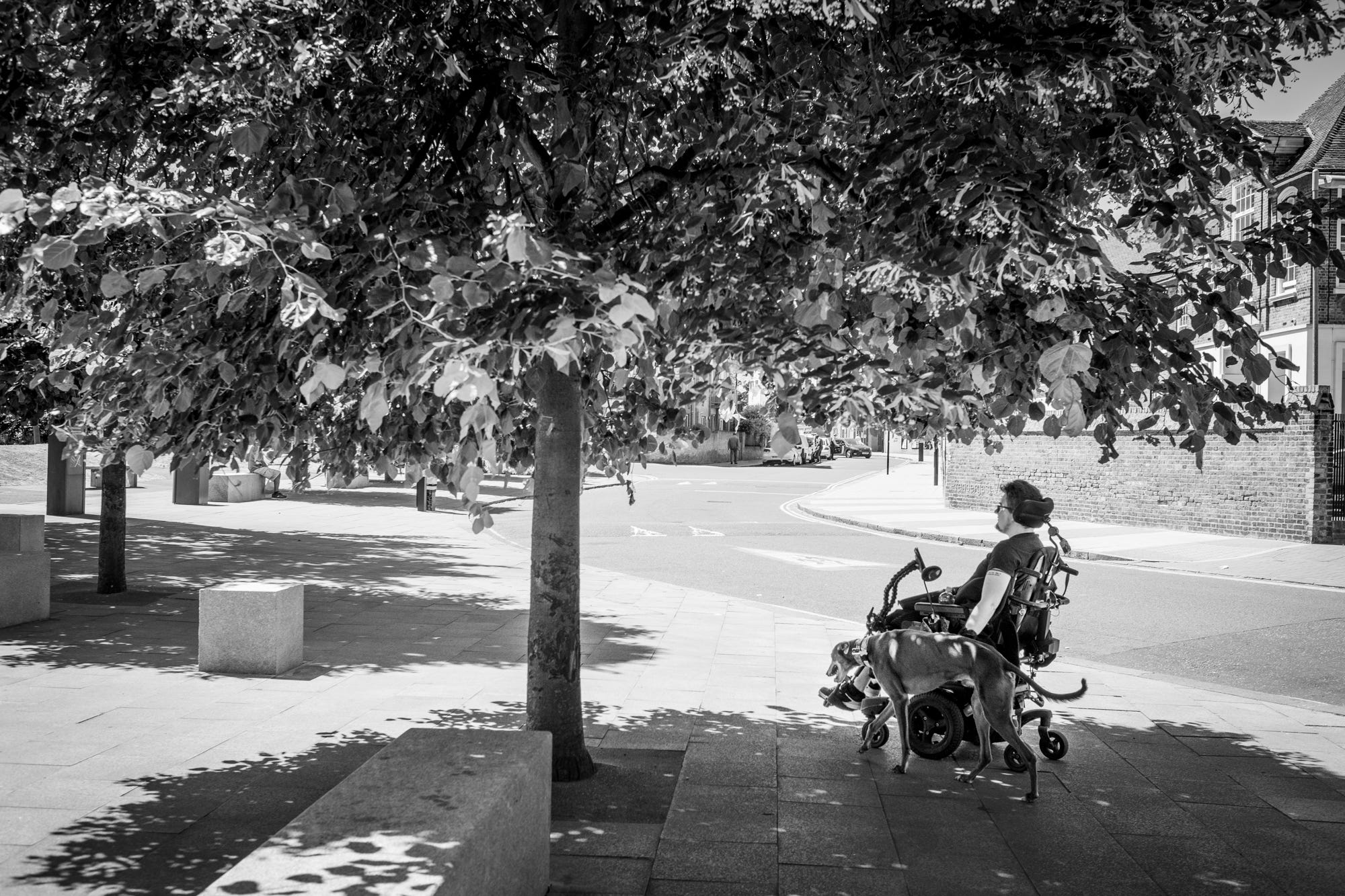
This post is a companion to my post on In/Visibly Disabled which will be published a few days later. This post explores some of the advantages and challenges of the in/visibility model of disability, whereas that post explores what it’s like to have lived as both, and to experience both.
Are You Visible or Invisible?
We often divide ourselves as disabled people into visibly and invisibly disabled, trying to account for whether people are immediately perceived as disabled by the (typically) non-disabled people around them. This is an intuitive split and has done a lot of work to ensure that the disabled community includes people who aren’t immediately read as disabled as well as people who are. It actively welcomes people who might have questioned their welcome, neurodivergent people, chronically ill people, people with mental health conditions. These people have been part of the disabled people’s movement from the start, but it feels like every generation we have to reclaim their/our place in it again (I say our, because I am one of those people, as well as being a wheelchair user), and this model helps with that. It names a very specific problem of “but you don’t look disabled” and works as a core part of a fight for legitimacy and understanding in situations where impairment isn’t immediately legible. In short, this model has a lot of value.
The Limits of This Model
However, as with every model, it has flaws as well as strengths, and I want to explore some of the gaps it leaves and the assumptions and challenges that come with it. This isn’t because we should discard it; it has a lot to offer us, but because, as with any model we use to describe the world, we should be honest about how it serves us, and how it doesn’t. I want to explore both of those areas here.
The in/visibility binary model puts the power to define us into the (typically non-disabled) people who are reading us and calling us visibly or invisibly disabled, rather than us naming an experience that arises from our own bodyminds. It’s presented to us as a fact about our embodied experiences, while actually sorting by how others read us, not how our bodyminds exist. And that’s challenging, because how we’re read isn’t static, as my own experience as a disabled person shows.
How we’re read also depends on who’s reading us, and as a disabled person I have two critiques of the in/visibility model here: how it privileges one sense, and whose perceptions it centres.
As a model, it’s centred on vision, making sight the master sense for sorting disability. We register disability through many channels, through what we hear of someone’s speech or the sounds they make, or how someone moves through space. A blind friend can hear my wheelchair and know I’m approaching. But the in/visibility model collapses all of that into the visual, which feels ironic as a way of organising a community that includes blind people and people with low vision, for whom “visibility” is neither how they navigate nor a meaningful axis for sorting disability.
It’s also focused on who’s perceiving us. Visibility means visibility to someone, and that someone is usually the non-disabled observer, not the disabled person who can identify another disabled person in a split second, even where they’d have been “invisible” to everyone else. It leans on a frame that centres the non-disabled person’s definition of disability. The binary becomes defined by who is doing the watching and the sorting, which means it centres the perceiver, not the perceived. It isn’t interested in my experience of being read, whether others recognise me as disabled, which of my needs they notice, what they then do about it, only in the reading itself, the perception others have of me - do I immediately appear disabled or not? This is rejected by the social model, which defines disability by barriers rather than by how it appears to the non-disabled. The vocabulary smuggles the abled gaze into the way we narrate our own experience.
In/Visibility and the Social Model
This is where the in/visibility model and the social model start to illuminate each other, because both are really naming how the world responds to us rather than describing our bodyminds. Disability is, according to the social model, situated in the barriers with which the world responds to disabled people, and the in/visibility model names two (floating, interlinked, non-mutually-exclusive) categories of disabled people and some of the experiences we have.
The categories of invisible and visible are sometimes presented as fixed, specific to the person (who is seen as being either invisibly or visibly disabled as a property of their personhood rather than a context-dependent interpretation), and as mutually exclusive. If we’re using the categories to talk about whose needs are identified and whose aren’t, then we need to acknowledge that, as I’ve experienced both when “invisibly disabled” and now as “visibly disabled”, fatigue and pain aren’t typically identified and accommodated for invisibly disabled people, but nor are they for visibly disabled people. The presence of my wheelchair tells people nothing about me being partially deaf, and makes that no more likely to be accommodated. In my experience, once people see the wheelchair, it crowds everything else out, because it explains me to others, and having other needs is also treated as excessive.
The Ubiquity of Invisible Impairments
There are very few people who are “visibly disabled” who don’t also have “invisible impairments”, access needs they’re not perceived as having. And similarly, people who are classified as “invisibly disabled” often come into visibility, pain and fatigue showing in how someone moves, a condition becoming legible in a flare. The leak between these categories is significant; it’s not just edge cases; many people live around that borderline.
I sometimes joke that on Zoom nobody knows that I’m in a wheelchair, and similarly nobody recognises my hearing aids until I point them out. Some of my conditions are obvious when I’m in an exacerbation and not noticeable the rest of the time, but I remain the same person. What about me is visible depends very much on the context, rather than being an innate property of me. This leaves me weighing up disclosure as a decision: do I mention that I’m deaf or not? Would I rather pay the cost of being legible or the cost of being illegible?
For me, visible and invisible are labels that exist in my experience concurrently, each naming and identifying different aspects of it, but they’re not something I could say “I am” inherently, because they bend and change with circumstances. The “grass is greener” argument of which “side” has it easier falls apart when we all occupy multiple spaces.
Visibility and Accommodation
One of the problems with the dichotomy of in/visibility is that it’s trying to do two jobs at once. It’s trying to identify who is immediately read as disabled and therefore as having needs, the people treated as legitimate, recognised and believed, and who isn’t. But it’s also trying to identify who has their needs met and receives accommodation, and who doesn’t. An assumption sneaks in here: that being recognised and seen as disabled makes your needs any more likely to be met. As someone who has existed both as someone immediately perceived as disabled and sometimes not, I’ve learned that visibility doesn’t guarantee accommodations at all.
Recognition as disabled is usually necessary to receive accommodations, but it isn’t enough. I have been recognised as disabled consistently, and yet many opportunities don’t provide wheelchair access, so I’m still excluded. I face discrimination in spaces, but I’m also often blocked from entering those spaces at all. I never know whether I’d rather face the discrimination I meet in the room as someone neurodivergent and partially deaf, or be blocked from entering the room at all as a wheelchair user. I think I’d prefer the former, but it’s hard to be sure.
There aren’t two ends to a spectrum, the visibly disabled, whose needs are recognised and accommodated, and the invisibly disabled, whose needs are neither recognised nor accommodated. There are just two different points where people’s needs remain unmet.
This brings me back to the social model. Being visibly or invisibly disabled is about how we’re perceived, not actually about our bodies. It’s relational, rather than fixed. It’s layers of experience time after time, rather than a single layer. It’s about who’s recognised, not who’s accommodated. All of these point me back towards the social model.
It locates disability in the mismatch between bodyminds and a world built to fit an imagined default. That mismatch is always relational, contextual, and barrier-specific, and so, of course, visibility is as well. And it isn’t about layers of privacy, but about recognising that legibility is one experience and accommodation is a separate one, that visibility may be about having needs identified, but doesn’t tell you whether those needs are met. Whether we’re treated as visible or invisible, this comes from a similar process, which declines to meet our needs regardless of visibility
Holding it Loosely
The in/visibility model is one I use cautiously. If we treat it as a master category, we fracture solidarity in the wider disabled community; we imply an oppression hierarchy that often seems to assume that visibly disabled people are automatically accommodated, and invisibly disabled people aren’t, and we end up telling people that one set of impairments disqualifies another, the overriding definition being whether someone you are “visible”.
There are so many models that are useful, if partial, dividing the community into people with fluctuating versus stable access needs, contested versus uncontested needs, acquired versus congenital conditions; or creating breakdowns by impairment type, and while none of these is complete, they’re all really useful, helping us explore where the barriers sit, and why different people have different experiences. For me, this is another of those models which has great service in helping us understand our community and experiences, but one that we shouldn’t allow to become the overriding way we think about disability.
I’ll keep using visible and invisible to talk about how the world reacts to me, but I don’t plan to use them as a binary description of who I am, or as shorthand for suggesting whether my needs get met.
I'm trying to get into your disable leadership event. 45 minutes and failing caroline.mawer@gmail.com