
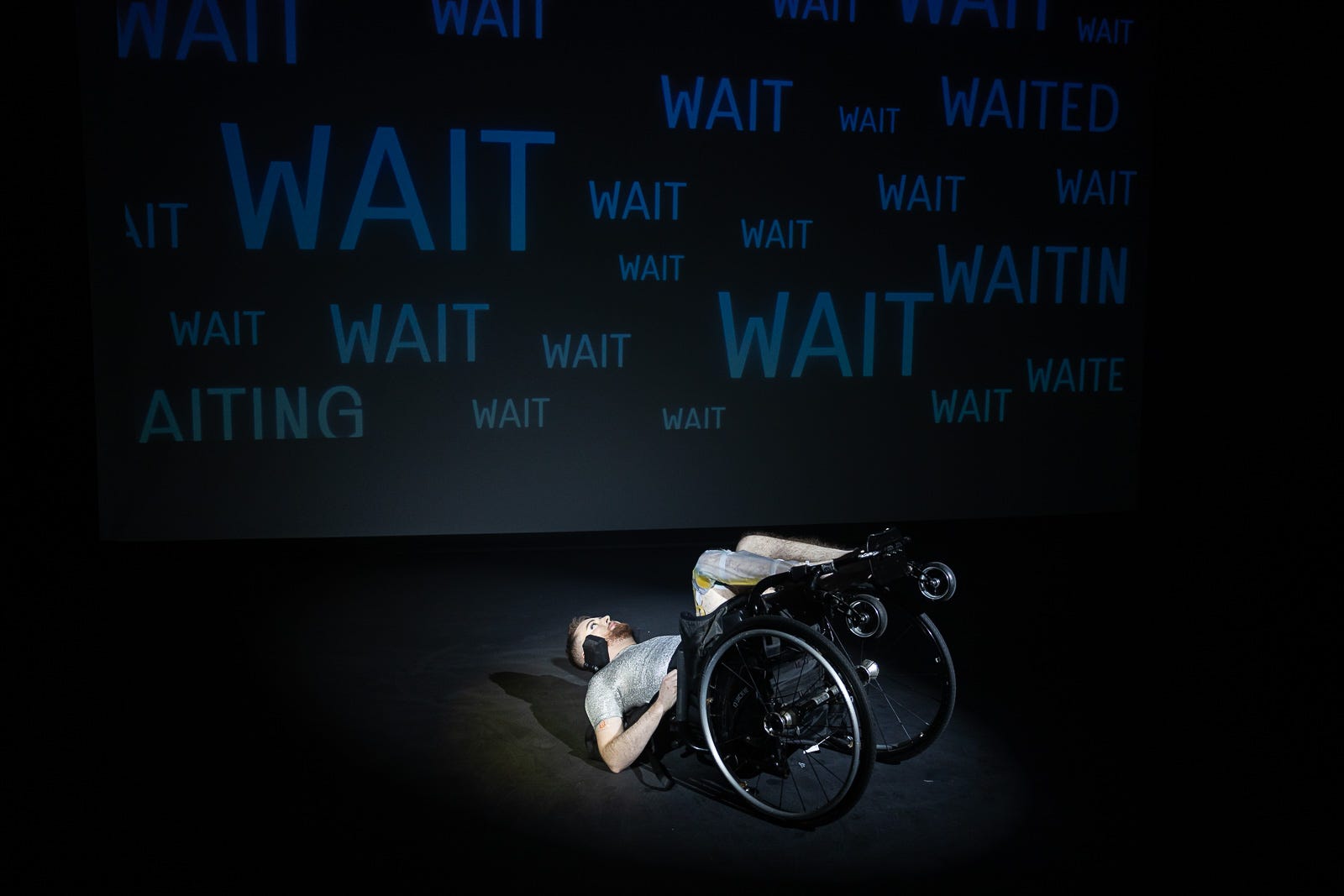
When someone says “this event will run on crip time”, we have come to a shared societal understanding of what is meant by that. That the event may run late, that it will be slow, and flexible, that it will leave time for people to exist at a reduced pace, a pace assumed to reflect chronic illness and disability.
As a crip, I often feel like I live in a world with a broken clock, but the broken clock is not just a slowed clock; for me, it’s a fundamentally shifted one, a new kind of clock that imagines its own rhythms and ways of being, sometimes in sync with another clock, sometimes mine alone.
The Shared Register
It is presumed that people exist on a shared register because we exist with a shared clock. Normative time is fiction, and we do not share a clock. Temporal structures, like the traditional 9-5, were designed to benefit certain bodies. Whether we’re looking at the minutes and hours in which we spend our day, the days, the weeks, the months, the seasons, the years, or the decades, in which we spend our lives, none of these structures are neutral.
They exist within a fiction of a shared temporal register that doesn’t actually exist. That temporal register benefits and meets the needs of a certain kind of body, and that body-mind, in general, isn’t ours; it isn’t a crip body-mind.
The Slow Register
When we talk about crip time, we’re usually talking about the slow register.
This is a register defined by fatigue, pain, and recovery; by the need to take time to rest in between activities; and the failure of the world to expect to make space for us to do so. This is a register in which time compresses, reshapes, and resists, and in which we are forced to confront time and our own need for rest. We must accept the fact that our bodies cannot live at the speed of capitalist production at which they are expected to.
Instead, disabled people may need to have more time to do the same things or to have different time, may need to work on different hours, at different schedules, at different points, with different support. This is something I very much need. As someone who lives with fatigue and with pain, I cannot sustain work at the same pace as somebody (a theoretical comparator who might be me but might not be disabled). But it’s not the only register that exists as crip time for me, crip time is not just a slowing and stretching, it mutates in other ways as well.
The Fast Register
Disabled people also exist in a fast register. This includes people with bipolar disorder who experience mania and hypomania, people who experience hyperfocus, which may be connected to ADHD or autism, and people who are rushing against the time of mortality with conditions that perhaps promise greater restrictions in the future than the present - or imply that there may not be a future at all.
Crip time can also involve having too much time, and compressing it can be a response to that. Working at a pace that would appear unsustainable can be the only response one has to a set of experiences that feel unsustainable.
I spend a lot of time in this fast register, only able to work in ways that seem too quick. I receive email responses that feel almost critical of me for replying too fast, as if I haven’t recognised that, as a disabled person, I should be leaving more time. It is as if my desire to complete everything (to tick everything off) didn’t result from a fear that I don’t have as much time to tick things off as other people might have.
The Circadian Register
We exist in a different circadian register. I am finding someone’s email signature: a note that they are sending emails at times that work for them, and that they do not expect other people to read or reply until times that work for them.
I feel like I often work on a different circadian register from other people. I am on medication that has a significant effect on my sleep architecture and really affects when I feel awake and vibrant enough to work, and when I am exhausted and restful.
I experience chronic pain, which reshapes my relationship to the night, turning it into a space which can become creatively generative as a way of pushing back and resisting against the pain I am in. I also experience a body shaped by chronic, long-term conditions that refuses the solar day, that sometimes sees the sun come up and calls for rest, and other times calls for energy.
None of this is about slowness or about speed, but about existing at a phase difference. I feel temporally out of sync with the world’s rhythm, almost entirely. This means I am often at my best working at times when others aren’t working. That asynchronicity is both isolating and freeing, allowing me to focus on the things I most want to focus on.
The Life Register
My life register isn’t that of a non-disabled person. Crip time doesn’t just shift the perception of days or weeks or months or seasons, but also the life course that stirs the whole body. It is a different experience.
Disability routinely disrupts and forecloses the normative development timeline. We experience our education interrupted, our careers fragmented, and our relationships strained by the unpredictability of our bodies and minds. The questions of milestones, such as marriage and children, also become complicated or closed. Those milestones arrive late, in the wrong order, or are replaced by others entirely.
We can have a complicated relationship to ageing - perhaps having been seen as having an early wisdom that comes from the life management skills acquired through illness, or perhaps ageing faster physically or psychologically than we could have been expected to. For some of us, we may also live with the knowledge that our timelines could be genuinely shorter than those around us.
Crip time isn’t just about the movement through an individual day, but also about the ways a life accrues meaning outside the standard shapes that life is given to us.
The Discontinuous Register
I exist in a discontinuity. Time is framed as being something reliable and continuous that moves from A to B to C to D over the course of a day, a week, or a life. This is a comfortable fiction that everybody loves, and that isn’t true for anybody, but is particularly untrue, perhaps, for disabled people.
The experiences that we have of flares and relapses, of changes in our needs and our abilities, reflect time breaking, skipping, and looping. They’re not just an experience of time running at the wrong speed, but of time running on a different track. The times when one is well enough to shine and succeed, and the times when one is not well enough to do so. And yet, we have similar expectations made of us regardless of where we are in that part of the cycle at that moment.
The Administered Register
Everything about my life as a disabled person feels administered. Slowness is not necessarily something inherent to us as disabled people, but also something that is enforced upon us. Slowness is structural: it isn’t just about our bodies, but about the way that our time is treated and understood as disabled people.
The waiting room and the hours that can be spent in it. The time lost to assessments and judgement, when surely we hold the expertise in our bodies and minds. The delays to paperwork, prescriptions, benefits, and access to work. Who controls the clock matters as much as what the clock does.
Everything makes it harder for us to exist and achieve along the lines of normative time that we have been trying to. That administrative register of slowness is not just one of slowness at all, but also one of rapidity.
Here too, speed is structural and is a crip experience: the crisis, the acute episode, the emergency that demands that we engage completely and immediately. The slowing and the speeding are not just things that are natural to us, but things that are done to us by a society that lays down its expectations firmly.
Crip Time
Crip time is, perhaps, a set of crip times. A set of ways that we encounter and live within a discontinuous and disjointed set of times, and a set of accommodations we make to try to balance that with the shape and pace of the lives we are living in the world. Maybe that discontinuity is part of what it means to be a crip in space and time, and maybe we can create and live from that position.
Loved reading this!
Thank you for this. So much.